

Partition Designs Between Living and Dining: Modern Ideas for Indian Homes
Table of Contents
Introduction
In most Indian homes the living room and the dining area share one continuous space. That openness feels generous, but it also blurs the line between where you relax and where the family eats. A well-planned partition solves this without boxing either zone in. Across three decades of building full home interior solutions, we have seen that the right divider does three jobs at once – it defines zones, adds storage, and becomes a design feature in its own right. This guide walks through practical partition designs between living and dining spaces, including modern hall partition designs that work in compact flats and larger homes alike.
If you are searching for room partition ideas that look modern yet stay practical, the key is to treat the divider as furniture, not just a wall. A good modern partition design for living room and dining hall earns its space by storing things, framing a view or filtering light. Below we cover the styles, sizes, materials and Vastu points that matter, so you can pick hall partition ideas that fit your exact floor plan and budget.
What Is a Living-Dining Partition?
A living-dining partition is any structure – solid, semi-open or freestanding – that separates the living room from the dining area while keeping both fully usable. Unlike a full wall, a partition rarely runs floor to ceiling on every side. It can be a slatted screen, a half-height cabinet, a glass panel, or an open shelving unit. The aim is separation without isolation: you mark the boundary while letting light and air move through.
Why Partitions Matter in Indian Living-Dining Spaces
A single combined hall has to serve many roles in a day. A partition gives each role its own corner without shrinking the room. These are the main reasons homeowners ask us for room partition ideas:
- Most 2BHK and 3BHK flats merge the hall and dining into one rectangle, so a visual break is needed.
- A partition hides dining-table clutter from guests seated in the living room.
- It can carry storage, display niches or a TV unit that a plain wall cannot.
- Open-plan homes need a cue that tells the eye where one function ends and the next begins.
- In rented or compact homes, a freestanding divider adds zoning without any civil work.
Modern Partition Design for Living Room and Dining Hall: 7 Ideas
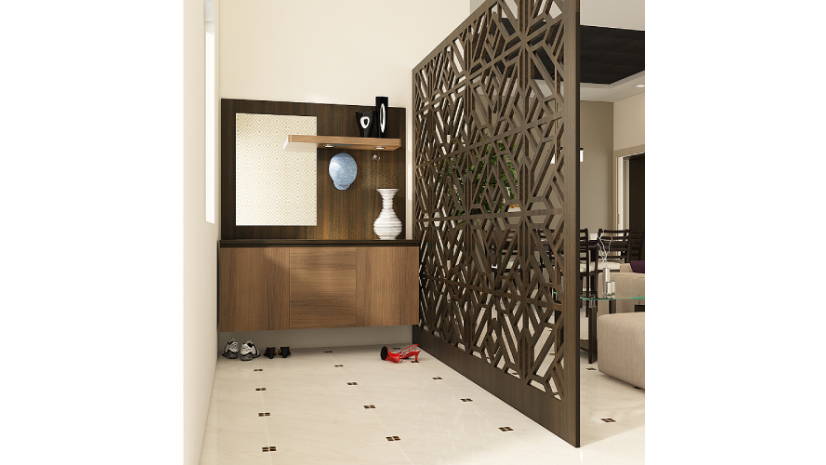
Below are seven partition designs between living and dining areas that we install most often. Each modern partition design for living room and dining hall suits a different budget, ceiling height and level of openness, so read these room partition ideas as a menu rather than a ranking.
Placement is the first decision, and it sets up everything else. These are the spots that work best in apartments:
- The north-east corner of the home, which Vastu traditionally recommends for prayer.
- A living-room wall, where a small pooja unit in living room settings stays part of daily life.
- A foyer or entryway niche that greets you as you walk in.
- An unused wall in the kitchen-dining zone, kept away from the sink and stove.
- A bedroom corner, only if it is screened with a shutter for privacy.
Whatever the spot, the idols should ideally face west so that the person praying faces east, and the unit should never sit directly under a bathroom or against a toilet wall.
1. Fluted or Slatted Wooden Partition
Vertical wooden slats – usually 18–25 mm fluted panels in MDF or solid wood – are the most popular modern hall partition designs today. The gaps between slats let light pass while still screening the view. A floor-to-ceiling slatted screen in a warm walnut or oak finish instantly warms up a neutral hall and pairs well with most flooring.
2. Open-Shelf or Bookshelf Divider
An open shelving unit, roughly 1.6–1.8 m tall, doubles as a partition and a display. Stagger the shelves so the dining side and living side each get usable niches for books, planters and curios. This is one of the most functional room partition ideas for families who need storage but do not want a heavy, closed look.
3. Framed Glass Partition
Black-framed clear or fluted glass gives a crisp, modern boundary while keeping the whole space bright. Glass works especially well in smaller flats because it separates the zones visually without making either feel smaller. Use frosted or reeded glass on the dining side if you want to soften the view of the table.
4. Jali or CNC-Cut Screen
A jali partition – cut from HDHMR, MDF or metal in a geometric or traditional pattern – brings texture and an Indian character to the hall. CNC machining lets you choose a custom motif, from simple lattice to floral. A jali screen filters light beautifully and is a strong pick when you want the partition itself to be the statement piece.
5. Half-Wall with a Cabinet Base
A half-height partition around 1.1–1.2 m tall keeps sightlines open above while giving you a solid base. Build a low cabinet into that base for crockery, table linen or board games, and top it with a quartz or laminate counter that can hold a lamp or serving dishes. This is one of the most practical hall partition ideas for everyday family use.
6. Sliding Partition Doors
When you sometimes want the spaces fully open and sometimes fully closed – during festivals, large meals or a child’s study time – sliding panels are ideal. Our modular door designs include slim-profile sliding and bi-fold systems in glass, laminate or veneer that tuck away neatly when not in use.
7. Green or Planter Partition
A row of planters in a slim trough, or a vertical green frame, marks the boundary while adding life to the room. Pair indoor-friendly plants with a low wooden or metal stand so the divider stays light. This works well in homes that get good natural light near the dining zone.
Hall Partition Ideas by Room Size
The best partition depends far more on your floor plan than on trends. Match these hall partition ideas to your space:
- 1BHK and studio flats: choose see-through dividers – framed glass, slim fluted screens or open shelves – so the single room never feels chopped up.
- 2BHK homes: a half-wall with a cabinet base or a bookshelf divider adds storage you genuinely need.
- 3BHK and larger homes: you have room for a statement jali screen, a full-height slatted wall or sliding doors.
- Low ceilings (under 3 m): keep partitions partly open at the top and avoid heavy cornices that press the ceiling down.
If your hall is narrow, lean towards vertical lines and open designs – tall fluted screens and glass frames draw the eye up and keep the room from feeling tight. For wide, open-plan homes, room partition ideas like a double-sided shelf or a low cabinet run let you zone the space generously while keeping storage on both faces.
Modern Partition Design for Living Room and Dining Hall by Budget
Budget shapes the material more than the idea. Here is roughly how the popular modern hall partition designs stack up:
- Entry budget: a freestanding open shelf, a planter divider or a laminate-finish fluted screen gives a fresh look with no civil work.
- Mid budget: a half-wall with a cabinet base, an acrylic-finish slat wall, or a framed glass panel adds storage and a premium feel.
- Premium budget: a custom CNC jali screen, a veneer slat wall or motorised sliding partitions turn the divider into the hero of the room.
Whatever the budget, a modern partition design for living room and dining hall should always be measured against your floor plan first – a beautiful screen in the wrong spot only blocks movement.
Modern Kitchen Partition Design Ideas
Many Indian dining areas sit right next to an open kitchen, so a modern kitchen partition design often pairs with the living-dining divider. A breakfast counter, a half-height ledge or a fluted screen keeps cooking smoke and clutter out of the dining view while still feeling open. When we plan modular kitchen designs alongside the hall, we match the partition finish to the cabinet shutters so the whole space reads as one design.
Materials and Finishes That Last
A partition is touched, leaned on and dusted every day, so material choice matters. These are the finishes we recommend most:
- MDF and HDHMR with laminate or acrylic: stable, budget-friendly and available in hundreds of shades.
- Solid wood and veneer: warm and premium, best sealed with a matte PU coat for durability.
- Powder-coated metal: slim profiles for glass frames and modern jali screens.
- Toughened glass: 8–10 mm for safety, in clear, reeded or frosted finishes.
Vastu and Practical Tips for Living-Dining Partitions
- Keep the partition from blocking the main walking path between the entry, hall and dining table.
- Leave at least 90 cm of clear passage on either side so the space never feels cramped.
- In Vastu terms, a light, see-through divider is preferred over a heavy closed wall in the centre of a home.
- Plan electrical points early if the partition will carry a TV, lamp or display lighting.
Common Mistakes to Avoid
- Building a solid, full-height wall in a small flat – it makes both zones feel boxed in.
- Choosing a partition finish that clashes with the flooring or the TV unit.
- Ignoring storage when a half-wall or shelf divider could have added plenty.
- Overloading an open shelf so the divider looks cluttered from both sides.
Why Spacewood for Your Living-Dining Partition
As Spacewood, India’s leading modular furniture manufacturer for over three decades, we design partitions as part of a complete, coordinated interior rather than a bolt-on. Our designers measure your hall, study how your family moves through it, and recommend partition designs between living and dining that balance openness, storage and style. Visit your nearest Spacewood experience centre to see finishes in person, or talk to the Spacewood design team to start a free design consultation.
Final Thoughts
A good partition does not just split a room – it makes both halves work harder. Whether you lean towards a fluted screen, a glass frame or a storage-packed half-wall, the right modern partition design for living room and dining hall will define your zones while keeping the home bright and connected. Start with your floor plan, pick a finish that ties into the rest of the room, and let the divider earn its place through storage and style.
Frequently Asked Questions
What is the best partition between a living room and dining area in a small flat?
For small flats, see-through dividers work best – a framed glass panel, a slim fluted screen or an open shelf keeps the single space feeling large while still marking two zones.
How tall should a living-dining partition be?
It depends on the goal. A half-wall around 1.1–1.2 m keeps sightlines open and adds storage, while a full-height slatted or jali screen gives more privacy. Avoid solid full-height walls in compact homes.
Are glass partitions a good idea for Indian homes?
Yes. Toughened 8–10 mm glass in a slim frame separates zones without cutting light, and reeded or frosted glass on the dining side hides clutter while staying bright.
Do partitions add storage?
They can. Bookshelf dividers and half-walls with a cabinet base give you display niches and closed storage for crockery, linen and everyday items – something a plain wall cannot offer.
What materials are used for modern hall partition designs?
The common choices are fluted MDF or HDHMR, solid wood with veneer, powder-coated metal frames, CNC-cut jali screens and toughened glass, finished in laminate, acrylic or matte PU.
How much space should I leave around a partition?
Keep at least 90 cm of clear walking space on either side so movement between the hall, dining table and kitchen stays comfortable.