

10 Crockery Unit Designs: Wall Mounted, L Shaped and Crockery Almirah Ideas for Indian Homes
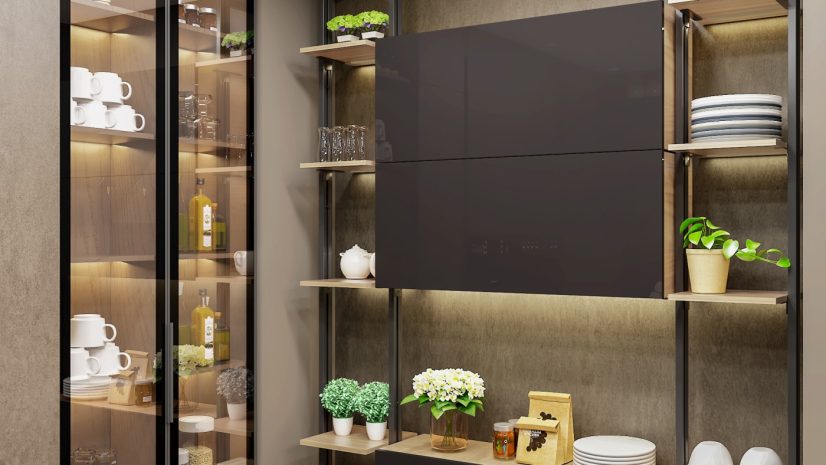
Table of Contents
Introduction
Every Indian home has two sets of crockery: the everyday steel and the ‘good plates’ waiting for guests. A well-planned crockery unit gives both a home – and turns the better set into display-worthy decor instead of a locked-away secret. Spacewood has built customised storage for Indian homes for over 29 years, and this guide covers the four formats buyers search for most: the wall mounted crockery unit design, the space-smart L shaped crockery unit, the built-in kitchen crockery cabinet design and the classic crockery almirah design – with sizes, materials and placement rules for each.
Why Does Every Indian Home Need a Crockery Unit?
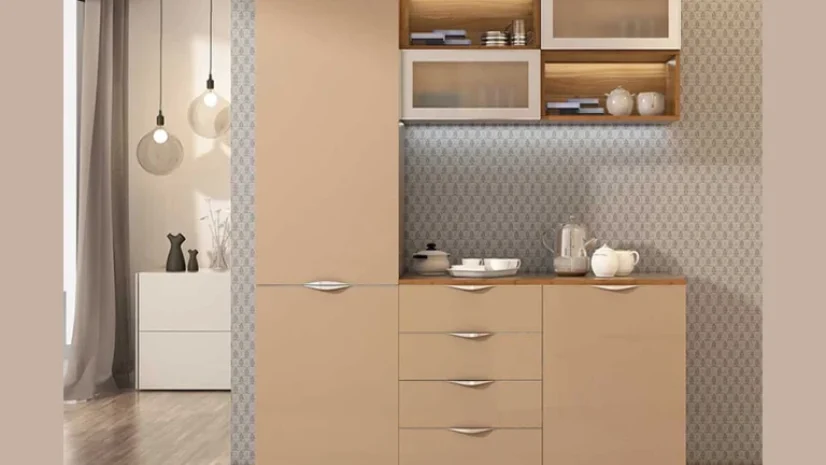
Because kitchens alone cannot cope. Dinner sets, glassware, serving bowls and festive thalis multiply with every wedding and Diwali, and stacking them in kitchen lofts means chips, dust and a stepladder. A dedicated crockery unit protects fragile pieces behind shutters, keeps daily-use ware within reach of the dining table and adds a designed display surface to the room. In open-plan homes it works even harder – a double-sided unit can separate the living and dining zones, as we showed in our partition design ideas.
What Are the Best Wall Mounted Crockery Unit Design Ideas?
A wall mounted crockery unit design floats above the floor, which makes cleaning easier and keeps a compact dining area visually light. The formats that work best:
- Floating glass-shutter cabinet: frosted or clear glass with warm LED strips for display.
- Ledge-and-cabinet combo: a closed box unit above an open display ledge for serving dishes.
- Full-width wall run: shallow 30-35 cm deep cabinets across the dining wall.
- Box-grid display: open cubes for curios and glassware, mixed with two closed boxes.
Keep a wall mounted crockery unit design at 40-45 cm above the counter or sideboard so the wall does not feel heavy, and anchor it into masonry – loaded crockery is heavier than it looks.
How Does an L Shaped Crockery Unit Maximise Corner Space?
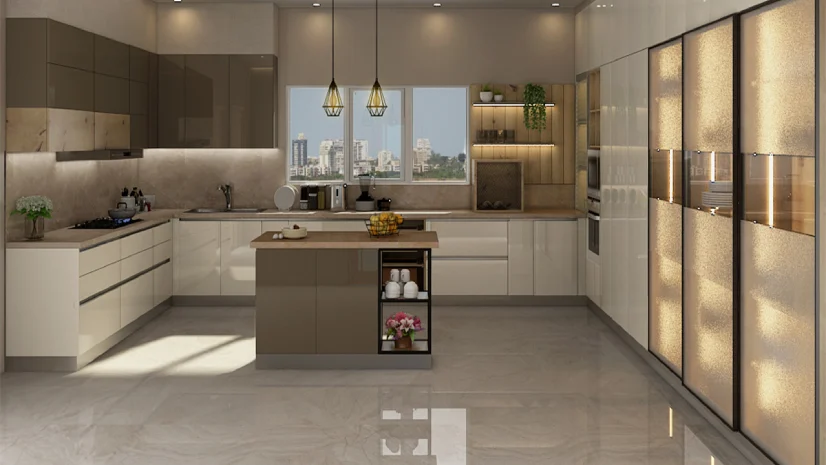
Corners are where dining rooms waste the most space, and an L shaped crockery unit claims them completely. One arm holds tall closed storage for stacked dinner sets, while the shorter arm carries glass display shelves that wrap the corner – so the unit stores more without projecting deeper into the room. An L shaped crockery unit also suits open kitchens beautifully: run the long arm along the kitchen’s outer wall and let the short arm turn into the dining zone, linking both spaces in one finish. For small homes, a corner-only version at 90 cm per arm still holds a family’s full crockery collection.
Which Kitchen Crockery Cabinet Design Suits Modular Kitchens?
Inside the kitchen itself, the smartest kitchen crockery cabinet design is built into the modular scheme rather than bought separately: a tall unit with glass upper shutters for display and closed lower storage for heavy stacks, or an extended base-and-loft run where the crockery section matches the kitchen shutters exactly. Position it at the kitchen’s dining-side end so plates travel the shortest distance to the table. A handleless kitchen crockery cabinet design in the same laminate as your modular kitchen looks factory-matched because it is – and our kitchen cabinet ideas guide shows shutter styles that pair well with glass display sections.
What Makes a Crockery Almirah Design Timeless?
The freestanding crockery almirah design – a tall cupboard with glass upper doors and closed lower storage – has survived every interior trend because it simply works. Modern versions of the crockery almirah design update the formula: engineered wood instead of heavy teak, soft-close glass shutters, built-in warm lighting and finishes from walnut veneer to ivory PU. A 6-7 ft crockery almirah design stores a joint family’s entire collection in one footprint and, unlike built-ins, moves with you to your next home. For traditional interiors, a wood-and-jali almirah adds character; for contemporary rooms, a slim-frame version with tinted glass reads almost like a display case.
Glass or Wood: Which Material Should You Choose?
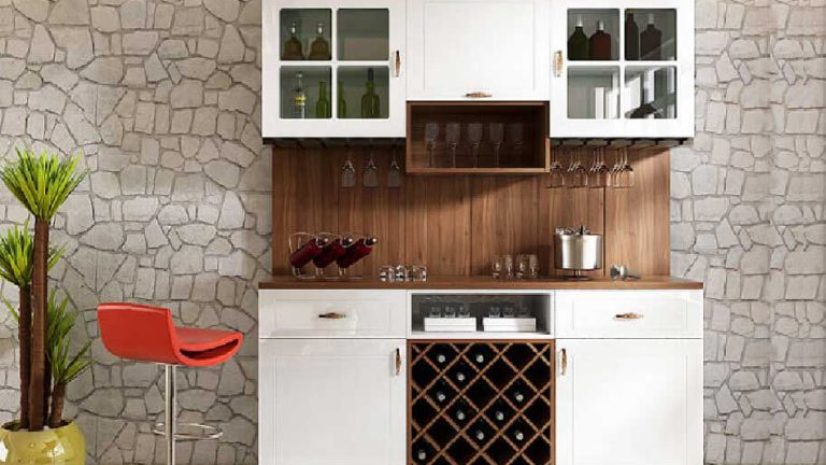
Use both, in the right places. Glass shutters – clear, frosted or fluted – belong on the upper display section where your best pieces live; toughened 5 mm glass is safe even in homes with kids. Closed wood or laminate shutters belong below, hiding mismatched daily-ware and heavy stacks. For the body, engineered wood with laminate or PU finish resists humidity and termites far better than site-made plywood boxes, and matte finishes hide fingerprints near the dining table. Add warm 2700-3000K LED strips inside glass sections – lighting is what separates a showcase from a cupboard.
What Size Crockery Unit Do You Need?
Match the format to your room with these working dimensions:
- Wall mounted crockery unit design: 90-120 cm wide, 30-35 cm deep, hung 40-45 cm above counter level.
- L shaped crockery unit: 120-180 cm on the long arm, 90 cm on the short arm.
- Kitchen crockery cabinet design: a 45-60 cm wide tall unit at the full kitchen depth of 60 cm.
- Crockery almirah design: 90-120 cm wide, 180-210 cm tall, 40-45 cm deep.
Whatever the format, keep display shelves 25-30 cm apart for plates and 35-40 cm for jugs and showpieces, and leave one empty shelf – collections only grow.
Which Crockery Unit Mistakes Should You Avoid?
Five mistakes we help families undo most often:
- Buying looks-first – a wall mounted crockery unit design without closed lower storage fills the dining table within a month.
- Ignoring the corner – if your dining room has a dead corner, an L shaped crockery unit almost always beats a flat wall run.
- Standalone styling in a modular home – a kitchen crockery cabinet design in a mismatched finish looks like an afterthought.
- Choosing a shallow crockery almirah design – anything under 40 cm deep cannot take full dinner plates on the flat.
- Skipping lighting – unlit glass shutters display dust, not crockery; warm LEDs cost little and change everything.
Conclusion
Pick the format that fits your floor plan: a wall mounted crockery unit design for compact dining walls, an L shaped crockery unit for corners and open kitchens, a matched kitchen crockery cabinet design inside the modular scheme, or a classic crockery almirah design that moves homes with you. Spacewood builds crockery units as part of our full-home modular designs in finishes matched to your kitchen and dining furniture share your wall size with us and we will design the rest.
Frequently Asked Questions
Where should a crockery unit be placed - kitchen or dining room?
Closest to where you serve. A dining-wall unit suits most homes; in open plans, place a kitchen crockery cabinet design at the dining-side end or use an L shaped crockery unit to bridge both zones.
What is the standard size of a crockery unit?
A freestanding crockery almirah design runs 90-120 cm wide and 180-210 cm tall; a wall mounted crockery unit design is 30-35 cm deep. Keep plate shelves 25-30 cm apart.
Which is better for a crockery unit - glass or wood?
Both: toughened glass shutters on top for display, closed wood or laminate below for daily-ware. Engineered wood bodies handle Indian humidity best.
What is the difference between a crockery unit and a crockery almirah?
A crockery unit is usually built-in or wall-mounted; a crockery almirah design is a tall freestanding cupboard with glass upper doors that can move with you.
Is a wall mounted crockery unit better than a floor-standing one?
For small dining areas, yes – a wall mounted crockery unit design frees floor space and keeps the room light. Large collections still need a floor-standing almirah or L-shaped unit.