

How to Choose the Best Chimney for Your Kitchen - Buyer's Guide (India)
Table of Contents
Introduction
Finding the best chimney for kitchen use in India is less about chasing a brand name and more about matching suction power, filter type and size to the way you actually cook. Indian cooking throws off heavy grease, steam and high-heat tadka smoke that a weak unit simply cannot clear. At Spacewood, India’s leading modular furniture manufacturer for nearly three decades, we plan the chimney, hob and duct route into the kitchen from day one – so this guide is written to help you buy the right unit and place it perfectly.
This is an evergreen decision guide, not a throwaway product list that goes stale in months. Instead of ranking models, we walk you through every choice that makes one chimney the best chimney for kitchen life in your home: m3/hr suction ratings, baffle versus filterless filters, ducted versus ductless venting, 60 cm versus 90 cm width, noise in decibels, price bands and installation height. Read it once and you will be able to judge any chimney on the shelf with confidence.
Why does an Indian kitchen need a chimney?
Indian cooking is uniquely tough on kitchen air. Deep frying, tempering whole spices in hot oil and searing over a high flame release oily aerosols that settle on cabinets, walls and the ceiling as a sticky grease film. A good chimney captures this at the source, before it spreads through your home. That is the whole reason the best chimney for kitchen use matters so much here compared with lighter Western cooking.
Beyond grease, a chimney pulls out steam, cooking odours and combustion by-products from your gas hob. This keeps your modular cabinets, laminates and false ceiling cleaner for longer, protects paint and makes the kitchen far more comfortable during long cooking sessions. For open and semi-open layouts it is essential – without it, tadka smoke drifts straight into your living room. Choosing the best chimney for kitchen air quality is therefore an investment in the whole home, not just the cooking zone.
What are the types of kitchen chimney?
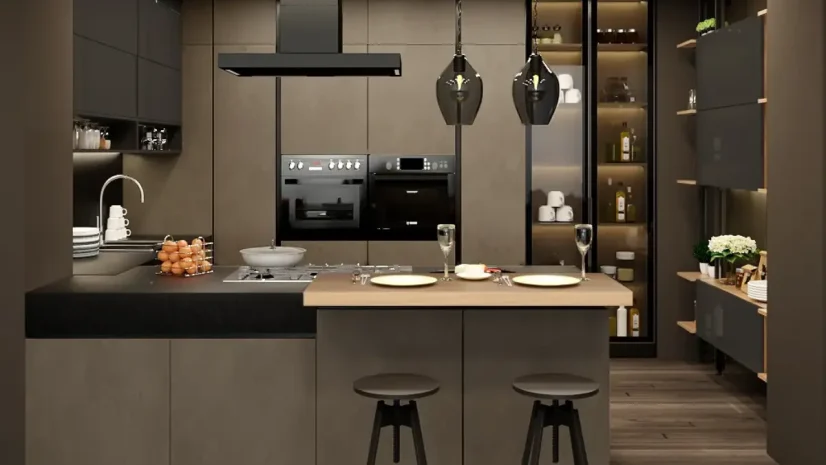
move into island territory – our island kitchen designs show how a ceiling-suspended chimney becomes a design centrepiece. If you are still finalising your plan, our guide to different types of kitchen layouts shows where the hob and chimney work best in each configuration.
Type | Best For | Mounting |
Wall-mounted chimney | Straight, L-shaped and parallel kitchens with the hob against a wall | Fixed to the wall above the hob |
Island chimney | Central island or peninsula hobs away from any wall | Suspended from the ceiling |
Built-in chimney | Seamless modular looks where only the working surface shows | Integrated into an overhead cabinet or hood housing |
Corner chimney | Hobs placed in a 90-degree corner junction | Angled across the corner |
Your layout usually decides the type for you. A wall-mounted unit is the most common of all the types of kitchen chimney because most Indian hobs sit against a wall. If your cooking platform sits in the middle of the room, you move into island territory – our island kitchen designs show how a ceiling-suspended chimney becomes a design centrepiece. If you are still finalising your plan, our guide to different types of kitchen layouts shows where the hob and chimney work best in each configuration.
Ducted vs ductless: which is right for you?
This is the single most important decision when picking the best chimney for kitchen use, and it is exactly where most buying guides go quiet. A ducted chimney vents grease and smoke outdoors through a pipe. A ductless (recirculating or filterless) chimney passes air through a charcoal filter and pushes cleaned air back into the room. The right choice depends almost entirely on whether you can route a duct outside.
Factor | Ducted | Ductless |
Performance | Removes heat, steam and odour fully; best for heavy frying | Reduces smoke and grease but leaves heat, steam and some odour |
Requirement | Needs an external wall or shaft within a few feet | No external duct; fits flats where venting outside is impossible |
Running cost | No charcoal filter to replace; lower over time | Charcoal filter replaced every 3 to 6 months |
Best suited to | Independent homes and flats with a nearby vent route | Apartments with no way to route a duct outdoors |
Our decision framework is simple. If you have an external wall or duct shaft near the hob, choose ducted – it is the better performer for Indian cooking, every time. Only if your apartment genuinely has no route to vent outside should you opt for ductless, and if so, invest in a higher suction rating and stay disciplined about replacing the charcoal filter. When we design a modular kitchen, we identify the duct route at the drawing stage so ducted stays an option wherever the building allows it. This one choice does more to define chimney performance than any other feature.
How much suction power do you need?
Suction power is measured in cubic metres of air moved per hour (m3/hr) and it is the number that matters most for Indian cooking. As a rule, aim for 1,000 to 1,500 m3/hr. Lighter cooking can manage at the lower end, while frequent frying and tempering deserve the top of that range or higher.
To size it properly, use a simple formula: multiply your kitchen’s volume (length x width x height in metres) by 10, because the chimney should exchange the room’s air roughly ten times an hour. A 3m x 3m x 3m kitchen is 27 cubic metres, so 27 x 10 gives 270 – but always round well up for Indian cooking and choose at least 1,000 m3/hr to handle heavy tadka bursts. More suction is almost always the safer choice, and it is the first spec we check when advising clients on the best chimney for kitchen use.
Which filter is best for Indian cooking?
The filter is the heart of any chimney, and the wrong one clogs fast under Indian frying. Here is how the common options compare so you can match the filter to how often you fry.
- Baffle filter: curved metal panels that separate grease from air using changes in direction. It handles heavy oil and masala cooking brilliantly and stays efficient even as it collects grease. This is the best filter for typical Indian kitchens.
- Mesh or cassette filter: layered aluminium mesh that traps grease but clogs quickly and needs frequent, thorough cleaning. Better suited to light cooking.
- Charcoal filter: used only in ductless chimneys to absorb odour. It is a consumable and must be replaced every few months.
- Filterless / auto-clean: no baffle or mesh in the airflow path. Grease is collected in an oil cup or blown clear by a blower, giving strong suction with very low maintenance. Excellent for high-heat Indian cooking if you want minimal cleaning effort.
For most Indian homes we recommend a baffle-filter or a filterless auto-clean chimney. Both cope with grease-heavy cooking far better than plain mesh, which is why they feature so often in a busy Indian household.
What size chimney should you buy?
Chimney size, or width, must match your hob so no smoke escapes at the edges. The chimney should be at least as wide as the cooktop, and ideally a touch wider. Use the table below to line up burners, width and suction in one glance.
Burners | Chimney Width | Suction (m3/hr) |
2 to 3 burners | 60 cm | 1,000 to 1,200 |
3 to 4 burners | 90 cm | 1,200 to 1,500 |
Wide hob / cooking range | 120 cm | 1,500+ |
The golden rule: match the chimney width to the hob and the cabinet cut-out. A 60 cm chimney suits compact kitchens, while the 90 cm chimney is the popular choice for most Indian family kitchens. When we plan a modular kitchen, we coordinate the 60 or 90 cm chimney with the hob size and the surrounding cabinets, using heat-safe finishes around the cooking zone so everything lines up cleanly and safely.
Best chimney for a small kitchen
A kitchen chimney for small kitchen spaces has to clear smoke without dominating the room. You do not need less performance – you need a smarter footprint. The good news is that small kitchens are often more enclosed, so air gets exchanged efficiently and even a compact unit clears the air well in a tight space.
- Choose a 60 cm width to match a compact 2 to 3 burner hob.
- Consider a built-in or slim wall-mounted model that tucks into an overhead cabinet for a clutter-free look.
- Keep suction at 1,000 m3/hr or more so a small kitchen still clears tadka smoke fast.
- A filterless auto-clean unit saves you from wrestling with filters in a tight space.
Smart storage and the right kitchen chimney for small kitchen layouts together make a compact space feel open. A well-chosen kitchen chimney for small kitchen setups keeps sightlines clean and the counter clutter-free. Some of our best open kitchen design ideas show how a well-placed slim chimney keeps a small or semi-open kitchen feeling airy.
Auto-clean, noise and other features
Two features separate a merely adequate chimney from the best chimney for kitchen life over many years: auto-clean and noise. Both are worth understanding before you buy, and both are easy to overlook in a showroom.
Auto-clean chimneys come in two broad styles. Heat auto-clean units gently warm the surface so grease liquefies and drains into a removable oil collector – you just empty the cup. Oil-collector designs on filterless models catch grease in a detachable tray. Either way, an auto-clean chimney dramatically cuts hands-on cleaning, which matters a great deal in a grease-heavy Indian kitchen.
Noise is the feature most guides ignore, yet it shapes daily comfort. Chimneys are rated in decibels (dB), and a quieter unit at full suction transforms the cooking experience. Look for 54 to 58 dB at the working speed – anything much above 60 dB becomes intrusive during long sessions. Higher-quality motors and blower designs deliver strong airflow while staying in that desirable range, so do not judge a chimney on m3/hr alone. Other useful touches include LED task lighting over the hob, touch or gesture controls, and a genuine warranty on the motor.
How much does a kitchen chimney cost in India?
Kitchen chimney prices in India span a wide range, and spending more usually buys quieter motors, better auto-clean and higher build quality rather than just extra suction. The table below sets realistic expectations by segment.
Segment | Price (Rs) | Typical Features |
Budget | 6,000 to 10,000 | Basic wall-mounted units, mesh or baffle filters, adequate for light cooking |
Mid-range | 10,000 to 18,000 | Filterless or baffle auto-clean, 1,000 to 1,200 m3/hr, better noise control |
Premium | 18,000 to 25,000+ | High suction, quietest motors, island or built-in designs, gesture controls |
For most Indian family kitchens, a mid-range auto-clean chimney gives the best balance of performance, noise and value. Chasing the cheapest option often means a louder motor and more cleaning, while the premium tier mainly buys refinement rather than raw capability. Weigh the price against the suction, filter and noise specs to find the right chimney for your budget.
Which chimney is best for Indian kitchen?
So, which chimney is best for Indian kitchen cooking specifically? The answer weaves together everything above: a ducted chimney wherever an external vent is possible, a baffle or filterless auto-clean filter to survive heavy frying, 1,000 to 1,500 m3/hr of suction, a width that matches your hob, and a motor that stays in the 54 to 58 dB range. That combination is what makes a unit the best chimney for kitchen use in Indian conditions.
In short, deciding which chimney is best for Indian kitchen use comes down to sizing and venting for your exact space, not buying the flashiest brochure. Get the suction, filter, ducting and size right and you will barely notice grease again. Get any one of them wrong and even an expensive unit will disappoint. When a client asks us which chimney is best for Indian kitchen layouts like theirs, we always start from the duct route and the hob width, then work outward to features.

How to choose kitchen chimney: the buying checklist
When people ask us how to choose kitchen chimney models without getting overwhelmed, we hand them this brand-agnostic checklist. Tick each item and you cannot go far wrong. It is the same short list we use internally to judge any chimney for a given home.
- Suction power: 1,000 to 1,500 m3/hr for Indian cooking; size it to kitchen volume x 10 and round up.
- Filter type: baffle or filterless auto-clean for grease-heavy cooking; avoid plain mesh if you fry often.
- Size / width: match the hob – 60 cm for 2 to 3 burners, 90 cm for 3 to 4 burners.
- Ducting: ducted if an external vent is possible; ductless only when no duct route exists.
- Auto-clean: heat auto-clean or oil-collector to slash cleaning effort.
- Noise: target 54 to 58 dB at working speed.
- Warranty: strong coverage on the motor, ideally several years.
- LED lighting: bright task light over the hob.
- Controls: intuitive touch or gesture controls you will actually use.
- Chimney height: plan for 26 to 30 inches (65 to 75 cm) above the hob.
Knowing how to choose kitchen chimney models this way keeps you objective in the showroom, where sales pitches lean on brand names rather than specs. Run every unit through the checklist and the shortlist gets short fast.
What is the right chimney height above the hob?
Chimney height is a detail most buyers miss, yet it decides whether all that suction actually reaches the smoke. Mount the chimney 26 to 30 inches (roughly 65 to 75 cm) above the hob. Too high and the suction weakens before it grips the rising smoke; too low and it interferes with tall pots and radiated heat from the burners.
We set this height precisely during modular installation, coordinating it with the overhead cabinet line and the false ceiling so the chimney looks built-in rather than bolted on. Getting the height right is the quiet difference between a chimney that merely runs and the best chimney for kitchen results you actually feel.
Planning the chimney into your modular kitchen
Here is where a modular-kitchen brand adds value an appliance retailer cannot. To be transparent, Spacewood designs and builds the modular kitchen around your chimney – we do not sell the chimney appliance itself. What we do is make sure it fits, vents and performs perfectly within your cabinetry, so the unit you buy actually behaves like the high performer it was rated to be.
At the design stage we plan the duct routing to the nearest external wall or shaft, allow for a false-ceiling soffit to conceal the pipe, and position the electrical point exactly where the chimney needs it. We coordinate the chimney, hob and cabinet cut-out so widths align, and we specify heat-safe, moisture-resistant engineered-wood finishes around the cooking zone. Built on European machinery at our Nagpur facility, our cabinets are engineered to live alongside heat and steam for years.
Layout drives placement too. A parallel kitchen suits a wall-mounted chimney on one run; an L-shaped kitchen usually vents along the shorter external wall; an island kitchen needs a ceiling-suspended island chimney with the duct routed through the ceiling. Our complete modular kitchen design guide explains how these decisions come together into one cohesive plan.
Maintenance and cost of ownership
A chimney is a long-term investment, so think beyond the sticker price. Baffle filters should be cleaned every 15 to 30 days depending on how much you fry; auto-clean units need only periodic oil-cup emptying and an occasional deep clean. Ductless chimneys add the recurring cost of charcoal filters every 3 to 6 months.
Over a chimney’s life, a well-chosen ducted auto-clean unit often costs less to run than a cheaper ductless one, because there are no charcoal filters to keep buying and the motor works less hard. Factor in cleaning time, replacement parts and electricity, not just the purchase price, and the true best chimney for kitchen value becomes clear. The cheapest unit on the shelf is rarely the cheapest to own.
Conclusion
Choosing the best chimney for kitchen use in India comes down to a handful of well-made decisions: pick ducted over ductless whenever you can vent outside, choose a baffle or filterless auto-clean filter for grease-heavy cooking, size suction to 1,000 to 1,500 m3/hr, match the width to your hob, and insist on a quiet 54 to 58 dB motor. Get those right, set the height at 26 to 30 inches, and your kitchen stays clean and comfortable for years.
When you are ready to build the kitchen around that chimney – duct route, soffit, electrical point and all – explore our modular kitchen designs and let us plan every millimetre with you. We will make sure your chimney does not just fit, but performs exactly as it should.
Frequently Asked Questions
Which chimney is best for an Indian kitchen?
The best chimney for kitchen use in India is a ducted unit wherever you can vent outside, fitted with a baffle or filterless auto-clean filter, 1,000 to 1,500 m3/hr of suction, a width that matches your hob, and a quiet 54 to 58 dB motor. That combination handles heavy frying and tadka smoke reliably.
Baffle filter or filterless: which is better for an Indian kitchen?
Both handle Indian frying well. A baffle filter separates grease using curved metal panels and is very reliable, needing a clean every 15 to 30 days. A filterless auto-clean chimney offers strong suction with almost no filter maintenance. For heavy tadka and frying, either is a good choice – pick filterless if you want the least cleaning effort.
How much suction power do I need for my kitchen size?
Aim for 1,000 to 1,500 m3/hr for Indian cooking. To size it, multiply your kitchen’s volume (length x width x height in metres) by 10, then round well up. Even for small kitchens, stay at or above 1,000 m3/hr so high-heat tadka smoke clears quickly.
Should I buy a 60 cm or 90 cm chimney?
Match the width to your hob. A 60 cm chimney suits a 2 to 3 burner hob and compact kitchens, while a 90 cm chimney suits a 3 to 4 burner hob and is the popular choice for most Indian family kitchens. The chimney should be at least as wide as the cooktop.
Ducted or ductless chimney for an apartment?
Choose ducted if your apartment has an external wall or duct shaft near the hob – it removes heat, steam and odour far better. Only choose a ductless (recirculating) chimney when there is genuinely no way to vent outside. If you go ductless, pick higher suction and replace the charcoal filter every 3 to 6 months.
Is an auto-clean chimney worth it?
Yes, for most Indian kitchens. Auto-clean chimneys use gentle heat or an oil collector to gather grease, so you empty a cup instead of scrubbing filters. Given how much grease Indian frying produces, the reduced cleaning effort easily justifies the modest extra cost.
How much does a good kitchen chimney cost in India?
Budget units run Rs 6,000 to Rs 10,000, mid-range auto-clean chimneys Rs 10,000 to Rs 18,000, and premium models Rs 18,000 to Rs 25,000 and above. For most families a mid-range auto-clean chimney offers the best balance of suction, low noise and value.
What is the ideal chimney height above the stove?
Install the chimney 26 to 30 inches (about 65 to 75 cm) above the hob. Set it too high and suction weakens; too low and it interferes with tall pots and radiated heat. This height is set precisely during modular kitchen installation.